Glamour and obscured reality
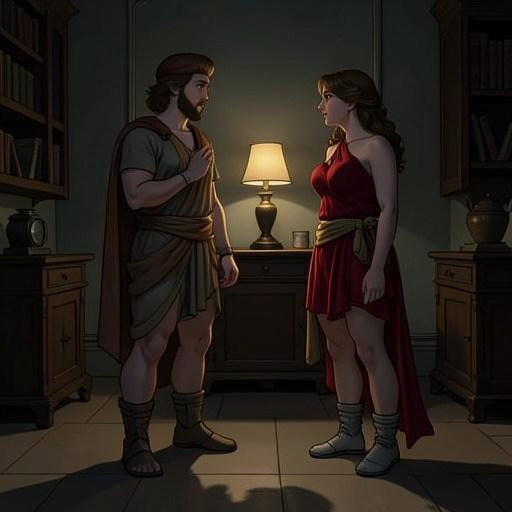
The ChangelingGlamour and obscured reality names a recurring danger in the story: appearances can disguise both supernatural threats and human vulnerability. Its force lies in the contrast between what seems safe or beautiful and what is actually present, a contrast Apollo Kagwa encounters first as a warning about how he presents his family and then as a failure of sight in the Northern Forest. Glamour does not merely conceal a monster; it can also make a child’s suffering, or a parent’s exposure to danger, difficult to recognize.
Appearance, exposure, and the ideal father
Jorgen Knudsen links contemporary habits of sharing to a practical loss of privacy. He describes parents posting the playgrounds their children visit, the times they are there, babysitter arrangements, and photographs of their schools. The problem, in his account, is not simply that people share too much, but that they do not know who can use what they reveal. The private home becomes exposed through apparently ordinary acts of documentation.
Jorgen applies this accusation directly to Apollo. He predicts that Apollo will record every moment of his child’s life, including the baby sleeping, and share those recordings online. He interprets this imagined behavior as a bid for public approval: Apollo, eager to be a better father than the one who raised him, would seek strangers’ praise to answer the pain of not having felt sufficiently loved as a child. That reading is Jorgen’s accusation, not a neutral account of Apollo’s motives. Its significance is that it makes an ideal image of fatherhood potentially dangerous: the effort to appear loving and attentive could leave a child exposed while the father fails to notice the risk.
Jorgen sharpens the point through the image of breadcrumbs leading a wolf to the door. In his warning, a parent’s public trail of information invites danger into the home, while confidence in being a perfect father distracts from the possibility that the child has already been taken. He describes the replacement as a Changeling, whose beauty is a projection of Apollo’s own vanity. The image joins social self-presentation to supernatural glamour: what appears attractive may reflect the observer’s desires rather than the being’s true nature. The warning does not establish that Apollo’s public behavior caused the danger; it shows how Jorgen frames parental pride and exposure as vulnerabilities an enemy can exploit.
The failure to see the supernatural
The divide between appearance and reality becomes literal when Emma Valentine tells Apollo that the figure before them was not a baby. Apollo then shouts that the Goblins were real and that he could not see them. His words mark a reversal: the threat had been present, but his perception had not registered it. The surrounding Northern Forest rises into a shout, and the cloud of energy around Emma parts. Apollo sees a thin woman in a ragged maroon puffer coat, holding a pewter serving tray, with cracked lips and puffy, yellowing eyes. The revelation replaces an obscuring spectacle with an image of anguish.
This moment makes glamour more than a disguise that can be taken off at will. Apollo’s earlier inability to see the Goblins leaves him unable to identify what is happening, even as Emma confronts the reality he missed. When the appearance gives way, the change is not toward a more beautiful or reassuring picture. It is toward visible distress. The scene therefore connects supernatural misrecognition with the broader habit of overlooking people whose circumstances do not fit an idealized image.
The skull and the suffering beneath appearances
Later, among the bones in the valley, Apollo holds a skull and decides that it belongs to Agnes Knudsdatter, the first abandoned child in Queens. Emma warns him that entering the place would be fatal. As Apollo moves backward, the bones clatter beneath his boots; he does not simply discard the skull, because dropping it again feels cruel. These details give the question of perception an ethical weight. The skull is not only an uncertain object to identify, but a possible remnant of a child whose abandonment might otherwise remain unseen.
Apollo sits beside Emma, replaces the serving lid on the tray to hide the Cooked sheep’s head, and keeps the skull in his lap. When he looks down again, it resembles only a large gray rock. That shift does not settle what the skull is; instead, it emphasizes how readily perception can recategorize an object and move away from its human meaning. Apollo nearly laughs, but feels too weak. He recognizes that glamour is especially consequential when it obscures the suffering of the weak.
Meaning and consequence
The concept gathers together several kinds of concealment without treating them as identical. Jorgen’s warning concerns the exposure created by parental oversharing and the seductive image of the perfect father. The Northern Forest scenes concern supernatural misperception and the anguish revealed when an appearance parts. The skull scene turns the same concern toward the material traces of abandoned children. In each case, the danger is not simply that something is hidden, but that a compelling surface can direct attention away from what needs to be recognized.
The final exchange gives this recognition an immediate practical consequence. Apollo proposes staying until morning, and Emma says that the Troll sleeps when the sun is up. Their plan depends on knowing the creature’s behavior rather than trusting how it appears. Against the false assurance of beauty, visibility, or paternal self-image, the story places attention to concrete signs: the missing child, the bones underfoot, the skull in Apollo’s lap, and the danger that must wait for daylight. Glamour matters because it can make those signs seem like something else, but the scenes also show that recognition begins when the characters attend to what appearance has concealed.